





Overview
Urine Analyzer LT-UA101 automatically receives and positions urine samples for analysis. The chemistry module dispenses the sample onto reagent strips and evaluates the reactions using photoelectric colorimetry. It measures parameters including glucose, protein, ketone, bilirubin, blood, nitrite, pH, specific gravity, microalbumin, creatinine, and other chemistry indicators. For sediment analysis, the urine sample passes through a four-channel fixed-flow counting cell. Digital images of the formed elements are captured automatically during sample flow. Medical image fusion and artificial-intelligence recognition are used to locate, identify, classify, and count sediment components. The system automatically performs aspiration, mixing, positioning, scanning, and cleaning to reduce manual handling. The two modules can operate online to generate a combined urine chemistry and sediment analysis report for comprehensive urinalysis.
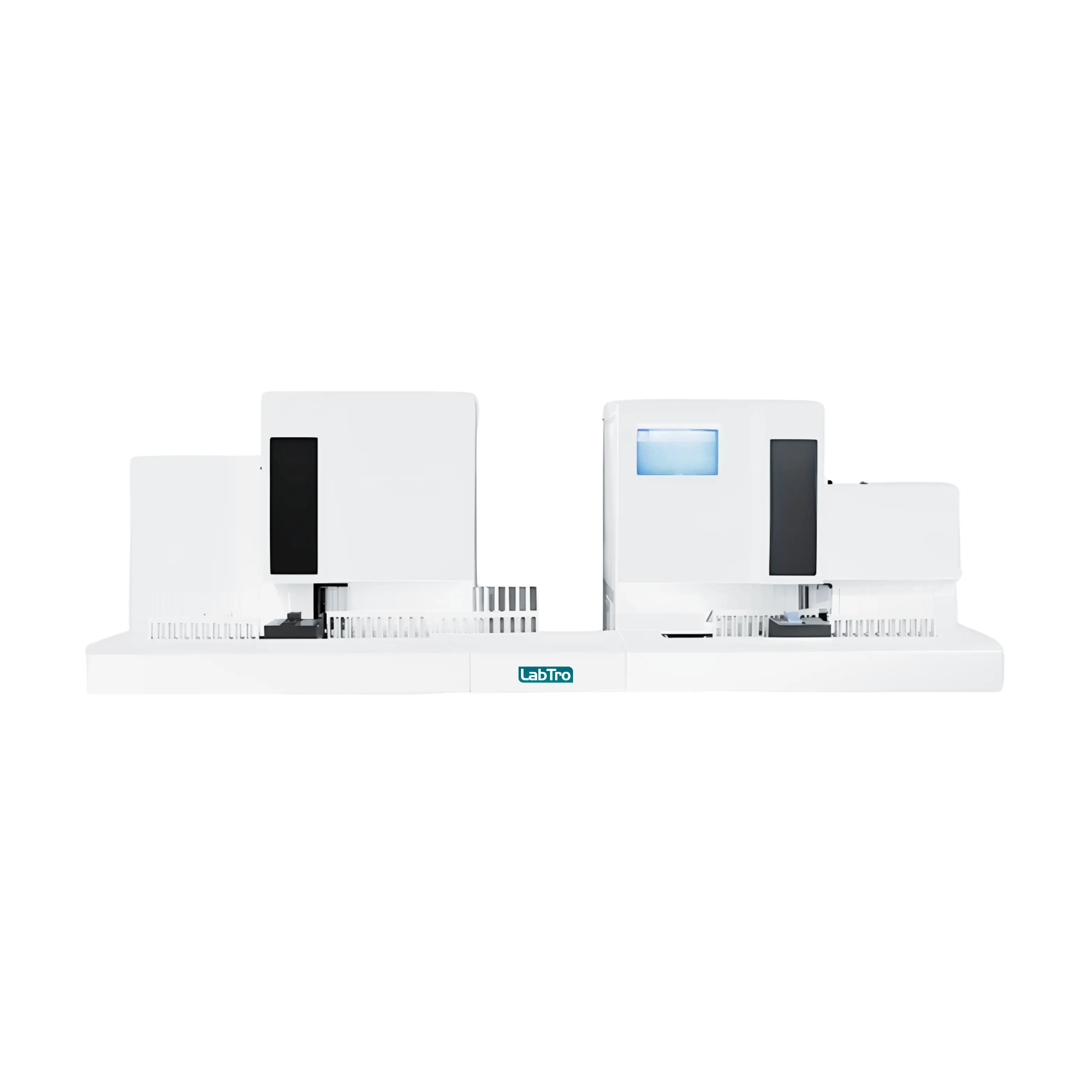
Technical Specifications
| System Configuration | Fully Automated Urinalysis Machine + Fully Automatic Urine Sediment Analyzer | Integrated Testing | Supports online chemistry and sediment testing with combined urine chemistry and sediment reporting |
|---|---|---|---|
| Chemistry Test Principle | Photoelectric colorimetric method | Sediment Test Principle | Flow-cell digital imaging technology, medical image fusion technology, artificial intelligence identification technique |
| Chemistry Throughput | 240 strips/hour | Chemistry Test Cycle | 15 seconds/strip |
| Sediment Throughput | 120 samples/hour | Chemistry Sample Capacity | 5 racks × 10 tubes |
| Total Chemistry Sample Capacity | 50 samples | Sediment Sample Loading | Fully automated 10-tube orbital sample grating with continuous sample feeding |
| Sediment Sample Area Capacity | Up to 60 samples at one time | Minimum Sample Volume | 3 mL |
| Chemistry Aspiration Volume | Less than 1 mL | Sediment Aspiration Volume | 1 mL |
| Chemistry Parameters | Urobilinogen (URO), Bilirubin (BIL), Ketone (KET), Blood (BLD), Protein (PRO), Nitrite (NIT), Leukocytes (LEU), Glucose (GLU), Specific Gravity (SG), pH, Ascorbic Acid (VC), Microalbumin (MAL), Creatinine (CRE), Calcium (CAL) | Number of Chemistry Parameters | 14 |
| Sediment RBC Parameters | Normal RBC, Standing RBC, Dysmorphic RBC | Sediment WBC Parameters | Normal WBC, WBCC, Pus Cell |
| Sediment Cast Parameters | Hyaline Cast, Granular Cast, WBC Cast | Sediment Epithelial Cell Parameters | Squamous Epithelial Cell, Normal Epithelial Cell |
| Sediment Crystal Parameters | Calcium Crystal, Oxalate Crystal, Amorphous Urates | Other Sediment Parameters | Sperm, Bacteria, Yeast, Mucus, etc |
| Sediment Counting System | Four-channel fixed-flow counting cell | Test Sensitivity | 5 cells/µL |
| Sediment Accuracy | >95% | Repeatability | CV <10% |
| Cross-contamination Rate | <0.05% | Original Urine Testing | Direct detection of original urine without centrifugation |
| Sample Processing | Automatic aspiration, mixing, positioning, scanning, identification, classification, counting, and analysis | Chemistry Automation | Automatic sample feeding, sample aspiration, sample dispensing, analysis, and report output |
| Sampling System | High-precision sampling system for accurate strip sample volume and reduced worktable contamination | Imaging System | Automated microscopic imaging for clear and complete sample capture |
| Image Processing | Medical image information scanning and image fusion technology | Recognition System | Artificial vision and artificial intelligence identification |
| Result Review | Operator can modify targets misidentified by the instrument | Learning Function | Corrected targets can be stored and automatically modeled after training |
| Aspiration Needle | High-precision plated PTFE suction needle | Pipeline Cleaning | Automatic thorough pipeline cleaning to minimize cross-contamination |
| Chemistry Data Storage | 20,000 results | Sediment Data Storage | 200,000 results |
| Report Units | Quantitative unit/µL and HPF | Report Format | Complete illustrated report combining urine chemistry and urine sediment results |
| Combined Reporting | Chemistry and sediment modules can operate online to provide a comprehensive urinalysis report | Processor | Each chemistry instrument module adopts a 32-bit ARM processor |
| Communication Architecture | CAN bus connection | Strip Control System | Unique IC card control system to reduce batch-to-batch differences of test strips |
| Software Upgrade | TF card upgrade and maintenance function | External Output | RS-232 |
| Printer | Thermal printer | Chemistry Power Supply | AC 220 V, 50 Hz |
| Sediment Power Supply | AC 220 V ±10%, 50 Hz | Chemistry Rated Power | 300 VA |
| Fuse | 250 V, 2 A | Operating Temperature | 15°C to 35°C |
| Optimum Temperature | 20°C to 25°C | Relative Humidity | ≤75% |
| Chemistry Dimensions (W × D × H) | 660 × 625 × 581 mm | Sediment Dimensions (W × D × H) | 660 × 440 × 570 mm |
| Chemistry Packaging Dimensions (W × D × H) | 785 × 570 × 1015 mm | Sediment Packaging Dimensions (W × D × H) | 1170 × 780 × 790 mm |
| Chemistry Net Weight | 65 kg | Chemistry Gross Weight | 85 kg |
| Sediment Net Weight | 47 kg | Sediment Gross Weight | 100 kg |
Features & Applications
Key Features
Fully automated urinalysis workflow
↳ Automates sample feeding, aspiration, dispensing, analysis, and report generation
Integrated chemistry and sediment analysis
↳ Combines dry-chemistry results with sediment findings in one comprehensive report
High-throughput processing
↳ Chemistry testing up to 240 strips/hour and sediment testing up to 120 samples/hour
Digital sediment imaging
↳ Uses flow-cell imaging and medical image fusion for formed-element analysis
AI-assisted identification
↳ Automatically identifies, classifies, counts, and analyzes urine sediment components
Four-channel counting system
↳ Supports continuous detection, sedimentation, and cleaning for efficient testing
Direct original urine analysis
↳ Samples can be automatically aspirated and mixed without centrifugation
Low cross-contamination
↳ High-precision PTFE aspiration needle and pipeline cleaning help maintain a cross-contamination rate below 0.05%
Large data storage
↳ Stores up to 200,000 sediment-analysis results
Automated result reporting
↳ Provides quantitative and illustrated reports with chemistry and sediment findings
Applications
Hospitals → Comprehensive screening of urine chemistry and formed elements
Diagnostic Centers → Detection and classification of RBCs, WBCs, casts, epithelial cells, crystals, bacteria, and yeast
Medical Laboratories → High-volume chemistry and sediment testing with automated sample handling
Urinalysis Departments → Combined reporting of physical, chemical, and sediment findings
Product Details